
Sources for Previous Residents of a Mineola Address
A Mineola address trail is strongest when a property record is paired with a source that speaks to a household or a built structure. The Nassau County Clerk maintains the land-record trail, while the Library of Congress, local collections, and federal schedules supply dated context. The exact run of local reverse directories has not been confirmed, so treat a library consultation as a necessary access step rather than assuming a complete online shelf.
| Source | Years It Covers | Where Held | What It Shows |
|---|---|---|---|
| Nassau deed and mortgage index | Certification display from March 30, 1992; image notice from February 22, 1994; archives reported to 1899 | Nassau Clerk, public terminals, and Map Room | Recorded parties, instruments, legal descriptions, and transfer trail |
| Electronic land database | Began in 1992 according to county annual-report material | Nassau County Clerk | Search layer, not proof every older image is online |
| Mineola Sanborn map | July 1917, 12 sheets | Library of Congress | Street, building, neighboring structure, and use at one date |
| Historical-directory lead | 1868 Curtin directory lead; Mineola entry not exposed | PML catalog | Starting point for a verified historical-directory search |
| Federal census | Released schedules through 1950 as of 2026 | Census, NARA, or library resources | Household at the time of enumeration |
| Village permits and C/O material | Historical index start not located | Mineola Building Department request | Project, owner or applicant, and building chronology |
The land index is about parties and instruments, not a list of every person who slept at an address. A census or directory is a dated household snapshot, not a title record. Keeping that distinction clear prevents a plausible address match from becoming an unsupported claim about previous residents.
Lock the Mineola Parcel Before Tracing Past Residents
Start with the physical address in Nassau AROW or the Land Records Viewer. AROW accepts street and ZIP, with house number, postal name, and Section, Block, and Lot fields available. The site advises entering only the street name, omitting directionals and suffixes, and using a partial street prefix when helpful.
Save the exact street spelling, town, ZIP, Parcel ID, and SBL. The Land Records Viewer adds village, town, school, tax-map, assessment, exemption, tax, and sales context. Its captured Mineola sample did not expose an owner name or mailing address, so do not fill that gap from a separate source without identifying its date and custodian.
Address terms. A situs is the parcel's physical location. An SBL is Nassau's Section, Block, and Lot identifier. A legal description is the title description that helps confirm the same land when a street address changes or is unclear.
Trace Mineola Previous Residents Through the Deed Chain
The backward trail begins with the current or most recent recorded deed, not with a broad surname search. The Clerk's Deeds/Mortgages portal offers name, document, book, section, reference, and recorded-date search modes. The result becomes useful only after its SBL or legal description is compared with the parcel you saved.
- Obtain the present situs and SBL in AROW or the Land Records Viewer.
- Search the Clerk index by section or reference, and then by the address-linked legal description when it is available.
- Record the grantor, grantee, recorded date, document number or book and page, and legal description from the most recent result.
- Use the prior grantee as the next historical party and search backward with the same parcel reference.
- At every transfer, compare lot dimensions, adjacent owners, map references, and dates before adding it to the chain.
A recorded transfer is not a move-in date, and a seller's next address may be outside Mineola. Later deeds, a directory, a probate file, or an obituary can test the story, but none should replace the parcel comparison.
Mineola Previous Residents Meet a 1992 and 1994 Online Split
Nassau's live land portal displayed an index certification range beginning March 30, 1992, while its image notice states February 22, 1994 to the present, with earlier records added periodically. County historical material reports deeds, mortgages, and maps back to 1899 and says the electronic database began in 1992. These are related but not identical coverage statements.
For an instrument from 1899 through 1991 that is not online, use the Clerk's public terminals or the Map Room, ask staff about deed books and grantor-grantee indexes, or submit a defined written request. The Clerk's current operating procedures allow land-record requests by e-recording, mail, delivery, lobby drop box, or in person. Search access is free, while image downloads, printed results, and certified copies can carry separate charges.
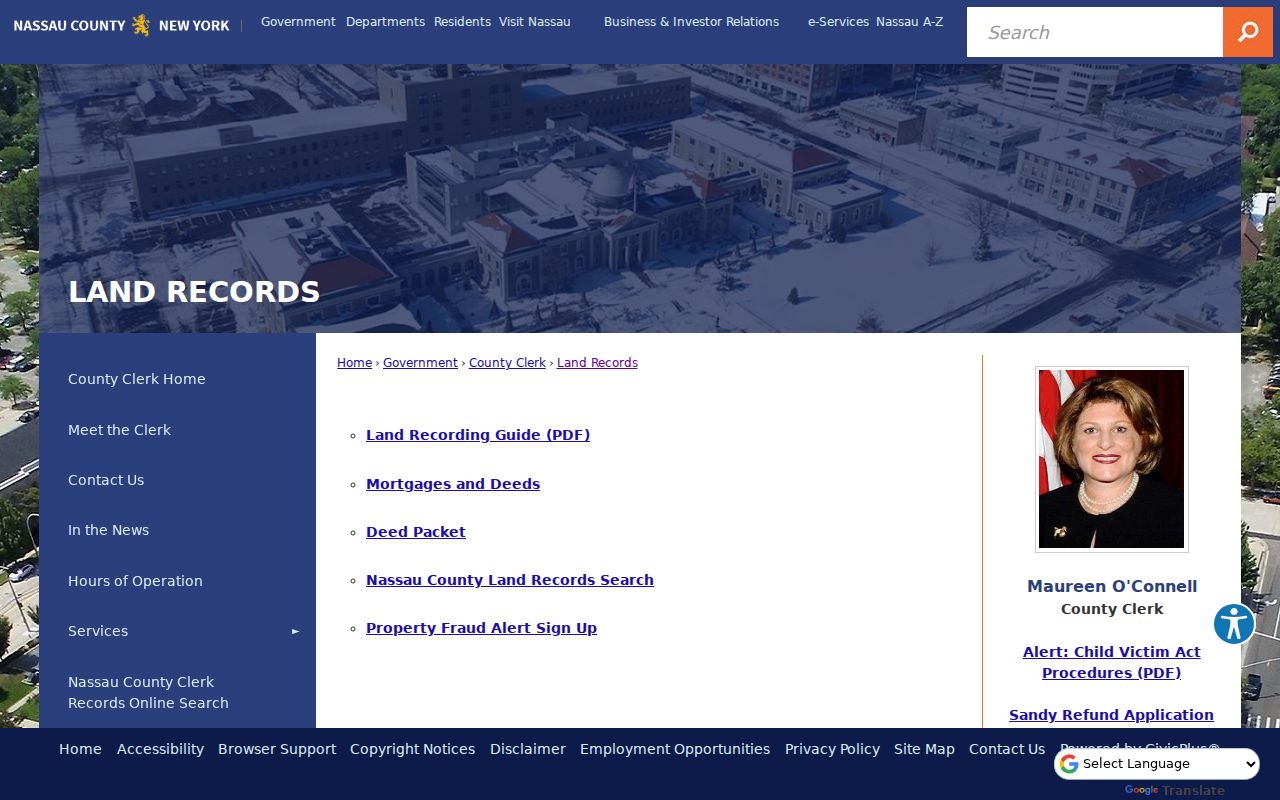
The Nassau County Land Records page links the official search and recording routes used to bridge the electronic and archival trail.
Pair Mineola Past Residents With Directories and Census
Once the deed chain establishes a parcel sequence, look for household evidence around each period. The research located a PML catalog lead to a Miriam J. Robbins historical-directories listing drawn from Curtin's 1868 directory, but it did not expose a Mineola entry or prove continuous coverage. Mineola Memorial Library and the Historical Society are the places to ask about reverse directories, telephone books, microfilm, obituary indexes, and yearbooks.
Read a verified directory entry exactly as printed. Capture the year, page, spelling, street line, and abbreviations, then compare adjacent years. Pair it with the federal census release that fits the era, not with an assumed complete run. As of 2026, released schedules extend through 1950 under the federal 72-year rule. A directory may be stale or show a business address, while a census is an enumeration snapshot.
For the collection focus rather than the address trail, the Mineola city directory collections page explains the confirmed digital holdings and the gaps that still need an onsite request.
Use the 1917 Mineola Map to Test a Past Address
The Library of Congress holds a July 1917 Mineola Sanborn record with 12 sheets, and East Williston appears as a secondary place. A sheet can show the building footprint, street label, adjacent structures, and land use at that date. It cannot identify a deed owner or every household member.
Use the map after the parcel trail is underway. Compare its street names and nearby structures with the legal description, later photos, and a directory line. This is particularly useful when an old address appears to have a spelling or number mismatch. No official Mineola street-renumbering year was found, so never manufacture one to make two records fit.
Mineola Past Residents Need the Clerk for a Certified Deed
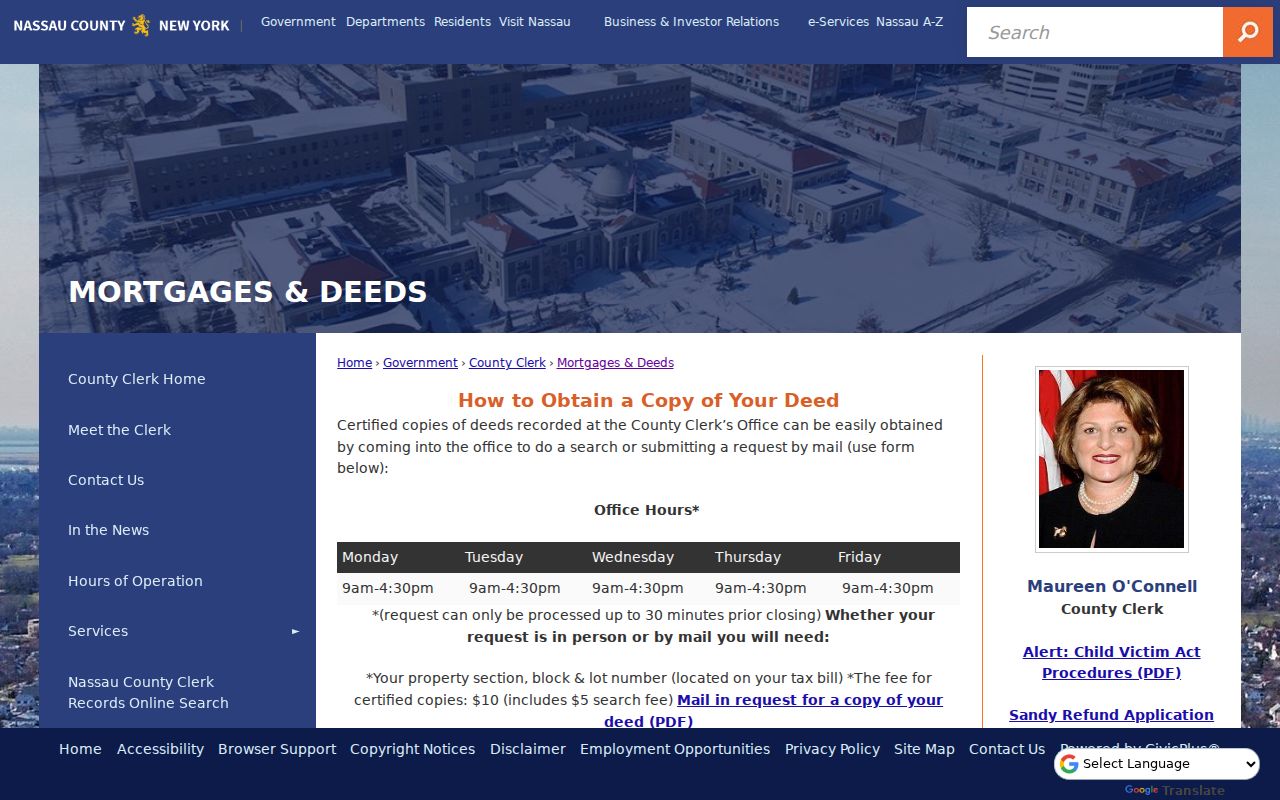
The Nassau County Clerk's Mortgages and Deeds guidance directs requesters to provide the SBL from the tax bill. The Map Room in basement Room B-1 has maps for every SBL and material for condominium, cooperative, and wetlands questions. A mailed request needs identifying contact information, the SBL or unit, payment to the Clerk, and a stamped return envelope.
The current page describes a certified deed copy at $10 by mail, including a $5 search. An archived request form gave different in-person and mail amounts, so reconfirm the current fee before sending payment. The Clerk does not provide ownership information by phone. A private invoice that looks official is not a County Clerk bill, and only the Clerk provides a legally equivalent certified deed.
Review the Clerk's Mortgages and Deeds instructions before requesting a certified copy for a Mineola address.
Mineola Previous Residents Need Local-History Fallbacks
Mineola Memorial Library's local-history page points to local photographs and the Historical Society. The Society, at 211 Westbury Avenue, holds more than 5,000 photographs and hundreds of objects reaching to the mid-1800s, with a free visit generally Monday through Thursday from 9:30 to 11:45 and other times by appointment. Ask whether staff can direct a researcher to physical books or identify a photograph; no formal house-history guide or service was found.
NY Heritage adds Mineola photographs, postcards, film and video, programs, and yearbooks. Its postcards cover early-1900s to 1920s material, with some through the 1960s, and programs can connect a place to a dated civic event. In 2024, the Historical Society created five new NY Heritage collections and digitized film and video work. That effort does not mean every house-history source is online.
Limits on a Mineola Previous Residents Search
Close an old address trail with an obituary or Surrogate's Court estate file only when the source supports it. WebSurrogate makes documents filed on or after February 19, 2014 available online, while earlier public material is available through courthouse access. A probate name is not evidence that someone remained at an address, and a public historical source should not be used to expose a protected present location.
There is no complete official Mineola obituary archive, funeral-home archive, church-register index, or confirmed local directory run in the research. When the official trail ends, ask the Library or Historical Society about onsite sources and make a narrow request to the custodian with an address, SBL, date range, and record type.
Lawful use. Mineola past-residents research is for house history, family history, and careful historical work. Do not use an old record to track, harass, or intimidate any living person.